ACTION ALERT: Stop the Proposed Dam on the Chehalis River
UPDATED: Submit a public comment on the Washington Department of Ecology’s Revised Draft Environmental Impact Statement (EIS) and oppose the Chehalis River Basin Flood Damage Reduction Project
Comments Due: February 4, 2026
What is this project and why does it matter?
In 2020 the Chehalis River Basin Flood Control Zone District (Flood District) proposed the construction of a flood-retention dam and reservoir on the Chehalis River near the town of Pe Ell. The original analysis under the 2020 draft EIS stated that the dam would have significant adverse effects including reducing fall salmon runs, degrading water quality, and increasing greenhouse gasses.

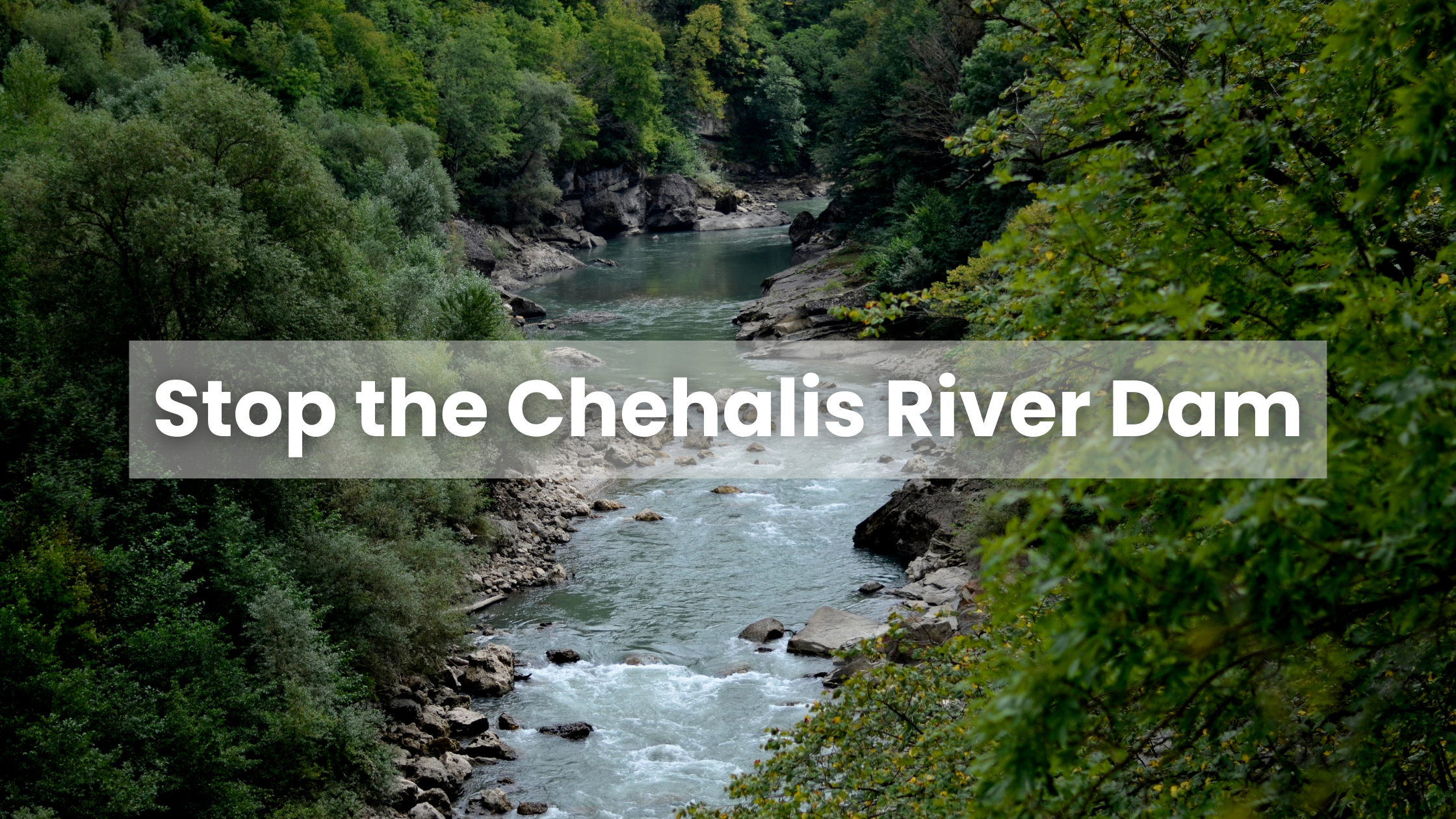
Image by Chehalis River Basin Flood Control Zone District
Since the initial proposal, the project applicants have made several changes to the proposal, restarting the state environmental review process. The draft state environmental review (EIS) is currently open through Wednesday, February 4, 2026, with the final review expected later in 2026.
The revisions on the proposed dam include massive changes to the original design and a location move to 1,000 ft upstream. The new proposal claims to have innovative designs that stop flooding while accounting for fish with an “open channel fish passage” that will be implemented throughout every phase of construction.
While a bypass channel is a potentially positive solution, the challenges in replicating natural river conditions, ensuring fish use of the bypass, and maintaining water quality during construction are significant concerns. Past fish passage projects where bypasses and fish ladders have been installed have seen mixed success. It is crucial to ensure that the project minimizes harm to fish populations and the overall river ecosystem.
How will this dam impact orcas and salmon?
The proposed Chehalis River Dam threatens the recovery of critically endangered Southern Resident killer whales and salmon populations, further jeopardizing their survival. These iconic species rely on healthy river ecosystems and abundant salmon runs. The proposed dam would block vital fish migration routes; including Chinook salmon which is the main food source of SRKWs, and risks devastating local fisheries.
How to Submit a Public Comment:
Attend the monthly Chehalis Basin Board meetings and make a public comment
Public comments are being accepted by the Washington Department of Ecology during the current comment period on the Revised Draft EIS. Comment period ends 2/4/26.
Submit your comment here:
https://admin.ecology.commentinput.com/?id=6U54ErkfW
Tips for public comment:
Avoid pre-written scripts and copy-and-paste templates. New practices make it so that pre-written templates only get counted once. Meaning if multiple people submit the same comment, letter, or email, it will only be recorded once. Make it personal and unique to make sure it is counted.
Cite resources and relevant data that support your comment. Scientific publications referenced in public comments MUST be addressed by policymakers and make for a strong public comment.
Be respectful and polite in your comments, emails, or phone calls.
Get personal, share your experiences, and explain why you care. Personal messages carry more sentiment and weight, which are more meaningful and can have a bigger impact on policymakers. To make this easy, we have included some suggested peer-reviewed and open-access scientific papers below.
Suggested talking points:
2024 saw the birth and death of three newborn calves (J60, L128, and J61) along with the loss of two adult breeding males (L85, and K26). The population is holding in the low 70s because there is not enough fish to sustain population growth. To ensure calves and breeding members survive, there needs to be enough fish to support growth. Constructing dams on critical salmon habitat will only further exasperate the lack of food, further risking the endangered Southern Residents.
The Chehalis River is a vital habitat for wild salmon, including Chinook salmon, which are crucial to the endangered Southern Resident killer whales. Construction of the dam would inundate approximately 847 acres and extend 6.2 miles, leading to the loss of critical spawning and rearing habitats. This alteration could significantly disrupt the life cycles of salmon species, potentially reducing their populations.
The remaining 73 Southern Resident killer whales are protected under the Endangered Species Act. Construction of a dam could pose a violation of this act as it poses a threat to the main food source (Chinook salmon) and the entire ecosystem on which the Southern Residents depend.
While the dam aims to reduce flooding, its construction could displace residents and businesses, leading to economic hardship and loss of community cohesion. Additionally, the dam's effectiveness in flood mitigation has been questioned, with concerns that it may not provide significant benefits to downstream communities.
The Chehalis River Basin is integral to the cultural and subsistence practices of local tribes, including the Quinault Indian Nation. The dam's construction would inundate tribal lands, disrupting traditional activities such as fishing, hunting, and gathering. The loss of salmon populations would further threaten the cultural heritage and food security of these communities.
Flooding caused by the dam could submerge or damage sites of historical and cultural significance to indigenous peoples, leading to the loss of irreplaceable cultural heritage.
The dam would alter the river's natural state, potentially reducing opportunities for recreational activities such as fishing, boating, and wildlife viewing, which are important to local economies.
The original analysis under the 2020 draft EIS stated that the dam would have significant adverse effects. According to the Department of Ecology, the adverse effects include:
Reducing fall-run Chinook salmon, Coho salmon, and steelhead trout (all of which are SRKW prey)
Reducing native aquatic species such as lamprey and freshwater mussels, and wildlife such as amphibians
Degrading habitat (land, water, and wetlands)
Degrading water quality in river and streams
Increasing greenhouse gas emissions
Other solutions to manage the flooding exist. Some of these include the Local Action No-Dam (LAND) Alternatives that promote options like floodplain restoration, improved drainage systems, levee improvements, building elevation, voluntary buyouts, and land use planning.
Click here to read the Orca Conservancy comment letter
Scientific Resources:
1. Southern Resident Killer Whale Recovery Framework
National Marine Fisheries Service (NMFS). (2008).
Southern Resident Killer Whale Recovery Plan.
NOAA Fisheries.
Key Point: Identifies prey limitation—specifically the abundance, size, and seasonal availability of Chinook salmon—as the primary limiting factor for Southern Resident killer whale recovery, and emphasizes protection of Chinook-producing watersheds as essential to recovery.
2. Southern Resident Killer Whale Status Reviews (ESA 5-Year Reviews)
National Marine Fisheries Service (NMFS). (2021).
Southern Resident Killer Whale 5-Year Status Review.
Key Point: Confirms that Southern Resident killer whales remain endangered, with prey limitation continuing to be the dominant threat, compounded by cumulative impacts from habitat degradation, vessel disturbance, and contaminants.
https://media.fisheries.noaa.gov/2022-01/srkw-5-year-review-2021.pdf
(NMFS status reviews from 2020–2023 reaffirm these findings through ongoing ESA monitoring and regulatory analyses.)
3. Effects of Dams on Salmon and River Ecosystems
National Research Council. (1996).
Upstream: Salmon and Society in the Pacific Northwest.
National Academies Press.
Key Point: Demonstrates that large dams fundamentally disrupt river ecosystems, reduce salmon productivity and life-history diversity, and impose long-term ecological costs that cannot be fully mitigated.
https://nap.nationalacademies.org/catalog/4976/upstream-salmon-and-society-in-the-pacific-northwest
4. Prey Availability and Southern Resident Killer Whale Recovery
National Marine Fisheries Service (NMFS). (2019–2023).
Effects of Prey Availability on Southern Resident Killer Whale Recovery.
Supporting analyses for ESA consultations and vessel regulations.
Key Point: Establishes a direct biological link between Chinook salmon abundance and Southern Resident survival, reproduction, and population growth, reinforcing that reductions in salmon availability have population-level consequences.
https://www.fisheries.noaa.gov/action/prey-increase-program-southern-resident-killer-whales
5. Washington State Orca Recovery Policy
Governor’s Southern Resident Killer Whale Task Force. (2018).
Task Force Recommendations and Priority Actions.
State of Washington.
Key Point: Establishes protection and restoration of Chinook salmon habitat as the highest priority action for Southern Resident recovery and cautions against new infrastructure projects that reduce salmon resilience.
https://www.orca.wa.gov/wp-content/uploads/TaskForceReport-2018.pdf
6. Washington State Orca Recovery Plan Implementation
State of Washington. (2019).
Southern Resident Killer Whale Task Force – Final Report.
Key Point: Reinforces science-based recovery actions focused on prey availability, habitat protection, and long-term ecosystem resilience.
https://www.orca.wa.gov/wp-content/uploads/TaskForceFinalReport-2019.pdf