ACTION ALERT: Protect Shasta River Salmon
Submit a comment urging the California State Water Resources Control Board to protect instream flows and ensure adequate water levels for salmon survival in the Shasta River.
Comments due April 30, 2026
What’s happening & why it matters:
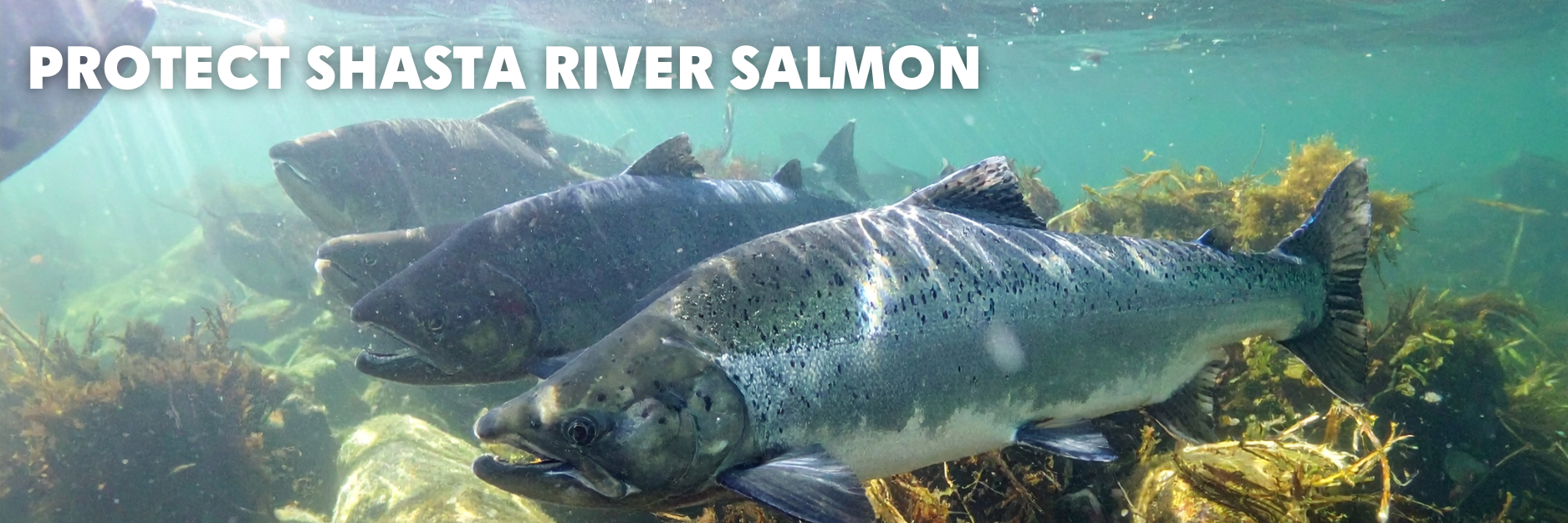
The California State Water Resources Control Board is currently reviewing water management and flow requirements in the Shasta River, a critical salmon-bearing tributary of the Klamath River.
This process will determine how much water remains in the river to support fish versus how much can be diverted for agricultural and other uses.
Low water levels in the Shasta River have already contributed to:
Elevated water temperatures
Reduced habitat availability
Barriers to migration and spawning
These conditions are particularly harmful to Chinook salmon, which depend on cold, well-oxygenated, connected river systems to survive and reproduce.
How this affects orca recovery
The Southern Resident killer whales (SRKWs) are a genetically distinct population of orcas that are critically endangered, with only 76 individuals remaining (this number includes new calves, K47 and L129, that are not captured on the current population census). The SRKWs’ primary food source is Chinook salmon, also called King salmon, and their survival is directly tied to the availability of healthy salmon stocks.
The Southern Residents range as far north as Southeast Alaska and as far south as Monterey Bay in Central California. Throughout their range, they rely on designated salmon stocks, but they do not rely on a single river system. Instead, the SRKWs depend on a coastwide network of salmon populations spanning from Alaska to California, and the Shasta River is part of that system.
Historically, the Shasta River supported significant runs of Chinook salmon. Today, those populations are a fraction of their former abundance, but they represent a critical opportunity for recovery.
The Southern Resident killer whales have been documented in California waters more frequently in recent years. Historically, sightings in California were rare, with only sporadic confirmed observations before 2019, including records dating back to 2007. Since 2019, documented sightings have increased substantially, with 75% occurring in the past three years, suggesting a shift toward more regular use of habitats along the Northern California coast, where the Klamath River system, which includes tributaries like the Shasta River, contributes to the broader prey base the SRKWs depend on. As ecosystems begin to recover and salmon habitat is restored following the removal of dams on the Klamath River, these trends may continue over time, as rebuilding a more abundant and resilient prey base supports the whales’ use of habitats across their range.
How to Submit a Public Comment
Send an email to: ScottShastaFlows@waterboards.ca.gov
Comments Due: April 30, 2026
See tips and suggested talking points below!
Tips for Submitting a Public Comment:
Avoid pre-written scripts and copy-and-paste templates. New practices make it so that pre-written templates only get counted once. Meaning if multiple people submit the same comment, letter, or email, it will only be recorded once. Make it personal and unique to make sure it is counted.
Cite resources and relevant data that support your comment. Scientific publications referenced in public comments MUST be addressed by policymakers and make for a strong public comment.
Be respectful and polite in your comments, emails, or phone calls.
Get personal, share your experiences, and explain why you care. Personal messages carry more sentiment and weight, which are more meaningful and can have a bigger impact on policymakers. To make this easy, we have included some suggested peer-reviewed and open-access scientific papers below.
Suggested talking points
The Shasta River is a critical salmon-bearing tributary of the Klamath Basin and historically supported significant Chinook runs
Maintaining adequate instream flows is essential to prevent:
Lethal water temperatures
Habitat loss
Migration barriers for spawning salmon
Scientific evidence shows that low flows and warm water conditions significantly reduce salmon survival at multiple life stages
Southern Resident killer whales depend on Chinook salmon for the majority of their diet and require a large, consistent prey base
SRKWs rely on salmon from across the entire West Coast, including the Klamath and its tributaries like the Shasta River.
Rebuilding salmon populations in tributaries like the Shasta contributes to a more resilient and stable prey base for the critically endangered Southern Resident killer whales.
Salmon are a keystone speices that supports a large number of species and ecosystems. Diverse salmon populations buffer against environmental variability and support predators through changing ocean conditions.
Protecting Shasta River flows is a necessary step toward restoring salmon populations in the Klamath Basin, a river system that contributes to the Southern Resident’s prey.
Salmon recovery efforts, including habitat restoration and dam removal, depend on sufficient and cool water to succeed
Water management decisions should be guided by the best available science and prioritize long-term ecosystem health
Scientific Resources:
Selective Foraging by Fish-Eating Killer Whales (Orcinus orca) in British Columbia
Ford, J.K.B. & Ellis, G.M.
Key takeaways: Demonstrates strong prey selection for Chinook salmon and dietary specialization
https://www.researchgate.net/publication/242521734_Selective_foraging_by_fish-eating_killer_whales_Orcinus_orca_in_British_ColumbiaEndangered Predators and Endangered Prey: Seasonal Diet of Southern Resident Killer Whales
Hanson, M.B., et al.
Key takeaways: Confirms Chinook salmon dominate SRKW diet across seasons
https://journals.plos.org/plosone/article?id=10.1371/journal.pone.0247031Species and stock identification of prey consumed by endangered southern resident killer whales in their summer range
NOAA Fisheries
Key takeaways: SRKW recovery is strongly limited by prey availability; increasing Chinook abundance is a primary recovery objective
https://www.researchgate.net/publication/238733682_Species_and_stock_identification_of_prey_consumed_by_endangered_southern_resident_killer_whales_in_their_summer_range