ACTION ALERT: Support Increased Vessel Protections for SRKWs in Canadian Waters
CANADA: Submit a public comment to support proposed amendments to the Marine Mammals Regulations that strengthen protections for Southern Resident killer whales.
Comments due before April 21, 2026
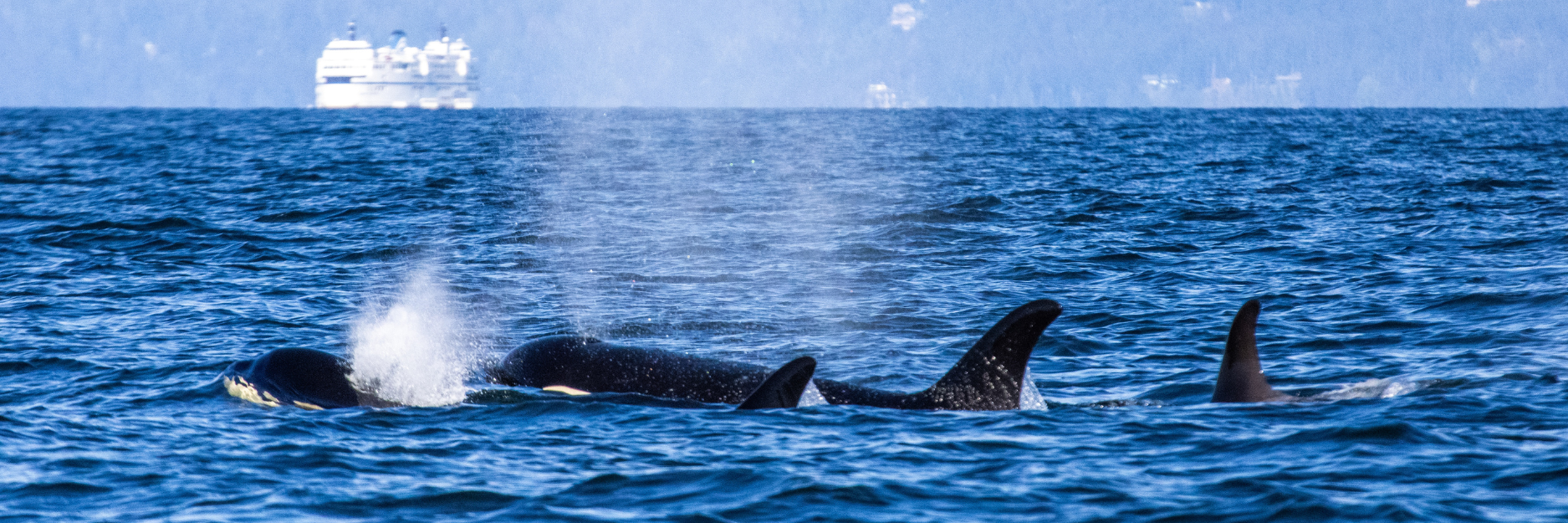
Members of J Pod in the Strait of Georgia, BC, Canada. Photo by Kendra Nelson
What’s happening & why it matters:
The Canadian federal government is proposing an amendment to the Marine Mammal Regulations that would strengthen protections for the critically endangered Southern Resident killer whales (SRKWs) by significantly increasing vessel approach distances.
Under current rules, vessels are required to stay at least 200 metres away, with an additional Interim Order (renewed annually over the past six years) by Transport Canada that extends protections to 400 metres. The proposed amendment would replace this approach by establishing a permanent, year-round minimum approach distance of 1,000 metres (1 km) for Southern Resident killer whales in Canadian Pacific waters.
This rule would apply broadly to all vessels, including recreational boaters, commercial vessels, whale watching, and more. By making this distance a permanent part of the regulations, the amendment would provide greater clarity, consistency, and enforceability. It would also bring Canadian protections more in line with those in Washington State, helping to create a more unified approach across the shared waters of the Salish Sea.
How Benefits Orcas
Southern Resident killer whales rely on sound for nearly every aspect of survival. They use echolocation to locate and capture prey, and vocal calls to maintain cohesion and coordinate within their family groups. Vessel traffic introduces chronic underwater noise into this system, which directly interferes with these essential behaviors.
Research shows that vessel disturbance reduces foraging success or causes the whales to stop feeding altogether. A NOAA-led study using suction-cup acoustic tags found that when vessels approach, whales are more likely to abandon foraging dives, with calves and nursing females showing a significantly stronger response, often abandoning foraging efforts entirely. For calves that rely on consistent nourishment for growth and survival, and for mothers that must meet increased metabolic demands, these disruptions can have direct consequences for survival and long-term population recovery.

J62 with members of J Pod in the Straight of Georgia, BC, Canada. Photo by Kendra Nelson
Not only does vessel noise pose a challenge for the SRKWs to locate food, it also causes them to expend more energy. A study by Marla Holt and colleagues found that Southern Residents increase the volume of their calls in direct response to vessel noise, a behavior known as the Lombard effect. This indicates that communication signals are being masked and that whales must expend additional energy.
Increasing vessel distance is one of the most effective ways to reduce these impacts. Noise intensity decreases with distance, meaning that greater buffer zones reduce both acoustic masking and behavioral disturbance. By minimizing close vessel interactions, increased approach distances help restore conditions where whales can hunt, communicate, and conserve energy more effectively.
How to Submit a Public Comment
Visit:https://gazette.gc.ca/rp-pr/p1/2026/2026-03-07/html/reg2-eng.html
Review the proposed amendments
Submit your comment before April 21, 2026
Tips for Submitting a Public Comment:
Avoid pre-written scripts and copy-and-paste templates. New practices make it so that pre-written templates only get counted once. Meaning if multiple people submit the same comment, letter, or email, it will only be recorded once. Make it personal and unique to make sure it is counted.
Cite resources and relevant data that support your comment. Scientific publications referenced in public comments MUST be addressed by policymakers and make for a strong public comment.
Be respectful and polite in your comments, emails, or phone calls.
Get personal, share your experiences, and explain why you care. Personal messages carry more sentiment and weight, which are more meaningful and can have a bigger impact on policymakers. To make this easy, we have included some suggested peer-reviewed and open-access scientific papers below.
Suggested talking points
Research shows that vessel noise reduces foraging efficiency in Southern Resident killer whales by masking echolocation and disrupting feeding behavior.
Studies have documented that when vessels are nearby, Southern Residents spend less time feeding and more time traveling or compensating for disturbance, resulting in measurable energy loss.
Acoustic research demonstrates that vessel noise overlaps with the frequencies whales use to detect prey, directly interfering with their ability to successfully hunt.
Southern Resident killer whales increase the volume of their calls in response to vessel noise (a behavior known as the Lombard effect), indicating that communication is being masked and requires additional energy.
Pregnant and lactating females are more likely to stop feeding in the presence of vessels, despite having the highest energetic demands in the population.
In a system already limited by prey availability, vessel disturbance compounds nutritional stress by reducing both the time available for feeding and the efficiency of each foraging attempt.
Underwater noise decreases with distance, meaning increased vessel approach distances are a direct, science-based way to reduce acoustic disturbance and improve foraging conditions.
Creating larger buffer zones around whales helps restore the conditions needed for effective hunting, communication, and energy conservation—particularly for mothers and calves.
While increased vessel distances do not address all threats facing Southern Residents, they represent one of the most immediate and actionable measures to reduce cumulative stress and support recovery.
Scientific Resources:
Vessel noise reduces foraging efficiency in Southern Resident killer whales
Williams, R., Lusseau, D., & Hammond, P.S.
Key takeaways: Vessel noise significantly reduces foraging opportunities; whales spend less time feeding and more time traveling or compensating for disturbance
https://www.int-res.com/journals/esr/articles/esr00154Noise impacts on SRKW communication and behavior (Lombard effect)
Holt, M.M., Noren, D.P., Veirs, V., Emmons, C.K., & Veirs, S.
Key takeaways: SRKWs increase call amplitude in response to vessel noise, indicating masking of communication signals
https://repository.library.noaa.gov/view/noaa/3541/noaa_3541_DS1.pdf