
ACTION ALERT: Protect the Endangered Species Act
Submit a public comment to oppose the proposed revisions by the US Fish and Wildlife Service (FWS) and National Oceanic and Atmospheric Administration (NOAA) to the Endangered Species Act (ESA) that would weaken long-standing protections for endangered species, including the critically endangered Southern Resident killer whales, and the endangered and threatened Chinook salmon stocks.
Public comments due Monday, December 22, 2025, by 11:59 PM EST.
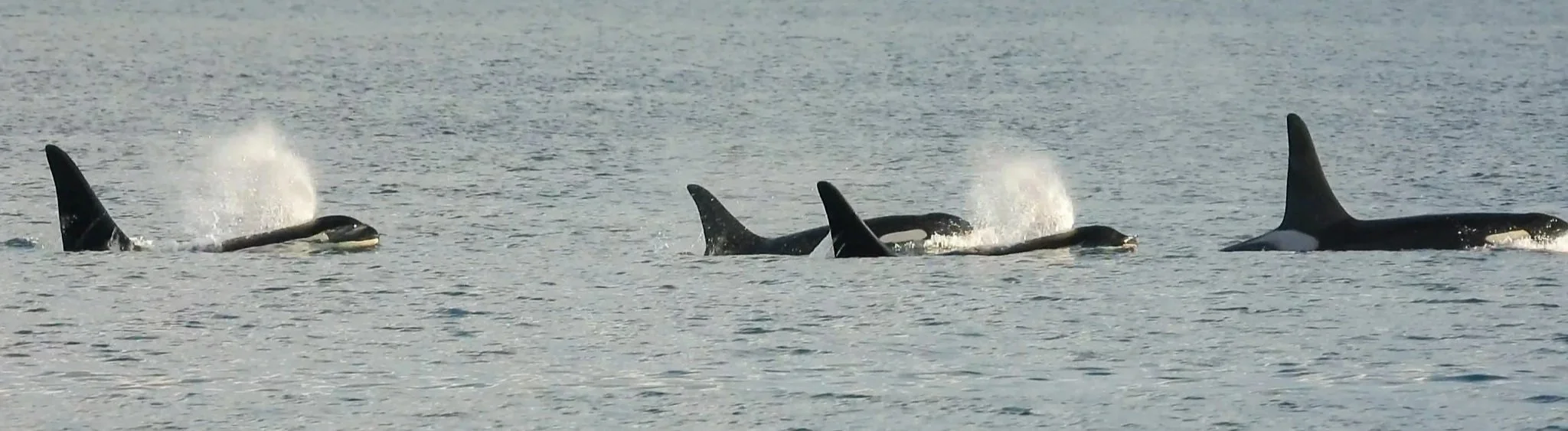
L105, L91, L110, & L106. Taken by Tamara Kelley
What is happening and why it matters?
The U.S. Fish and Wildlife Service (FWS) and National Oceanic and Atmospheric Administration (NOAA) have published four proposed revisions to key Endangered Species Act (ESA) regulations that could weaken and roll back long-standing protections for imperiled species like the critically endangered Southern Resident killer whales (SRKWs), and many of the threatened and endangered Chinook salmon stocks that they depend on.
Below is a breakdown of each proposal:
1. Changes to listing, delisting, and critical habitat designations (ESA Section 4)
Docket Number: FWS–HQ–ES–2025–0039; NMFS-251105-0168
This proposal would revise the criteria used to list species as endangered or threatened under the Endangered Species Act, as well as how critical habitat is defined and designated.
ESA listing decisions are legally required to be based solely on the best available scientific and commercial data. These criteria are intentionally precautionary, recognizing that early protections are essential to prevent population collapse and to preserve the ecosystems species depend on. Changes that narrow definitions, reinterpret scientific standards, or introduce additional discretion risk delaying protections until species are already in severe decline, when recovery is more difficult, more costly, and in some cases no longer possible.
Why this matters:
ESA listing decisions are required by law to be based solely on the best available science. Changes that narrow definitions or introduce additional discretion risk delaying protections until species are already in severe decline, which in turn reduces the chances of recovery by costing valuable time and resources and pushing species closer to the point of no return, when intervention may no longer be effective.
This proposal would make it more difficult to designate unoccupied but essential habitat in the future, which undermines species recovery, particularly for wide-ranging and highly mobile species like Southern Resident killer whales.
Critical habitat is not limited to areas where a species is currently found; it also includes habitat that is necessary for recovery, resilience, and long-term survival.
How will this impact orcas and salmon?The current SRKW critical habitat designation includes areas Southern Residents have rarely or never used in recent decades, a foresight that has proven essential. Recent use of places like Carr Inlet (2025) and Penn Cove (2024) after decades of absence, as well as intermittent and increasing use of Rosario Strait, highlights why habitat protections must extend beyond the most heavily used areas, as prey availability and ocean conditions shift with climate change.
Protecting only areas that are heavily used today ignores the reality that species must be able to adapt, explore, and reoccupy habitat as conditions change. Habitats that are lightly used, seasonally used, or not currently occupied may still be essential for recovery, particularly as prey distributions shift and ecosystems respond to warming waters.
2. Weakening protections for threatened species (ESA Section 4(d))
Docket Nubmer: FWS–HQ–ES–2025–0029
This proposal would change how protections are applied to species listed as threatened under the Endangered Species Act.
Under current regulations, species listed as threatened generally receive the same core protections as endangered species unless specific, science-based exceptions are established. This approach reflects the ESA’s preventative purpose: acting early, before populations decline to critically low levels.
The proposed changes would remove these default protections and instead require species-specific rules before safeguards apply. This proposal applies to species listed as threatened under the ESA, including many Chinook salmon populations critical to Southern Resident killer whale recovery.
The proposed changes seek to weaken the environmental protections, which are vital to the recovery efforts of the Southern Residents and salmon on which they depend.
Why this matters:
This change creates delays and gaps in protection at a critical point in a species’ decline, when early intervention is most effective.
Pacific salmon are a clear example. Many salmon populations are listed as threatened precisely because they are at a tipping point and facing cumulative pressures from habitat loss, altered river systems, warming waters, and declining prey availability. Immediate protections are essential to prevent further decline.
How will this impact orcas and salmon?Under the proposed approach, threatened salmon populations could face periods with reduced or incomplete safeguards while species-specific rules are developed. During these gaps, harmful activities may proceed without adequate protections, even when risks to salmon habitat and survival are well documented.
Population declines can accelerate rapidly, recovery becomes more costly and complex, and the window for successful intervention narrows. Weakening protections for threatened species shifts the ESA away from early action and toward crisis response, creating a far more expensive and less effective conservation strategy.
Loosened and weakened protections to threatened salmon stocks will have a direct impact to the SRKWs, who are already vulnerable and dependent on many endangered and threatened Chinook salmon populations.
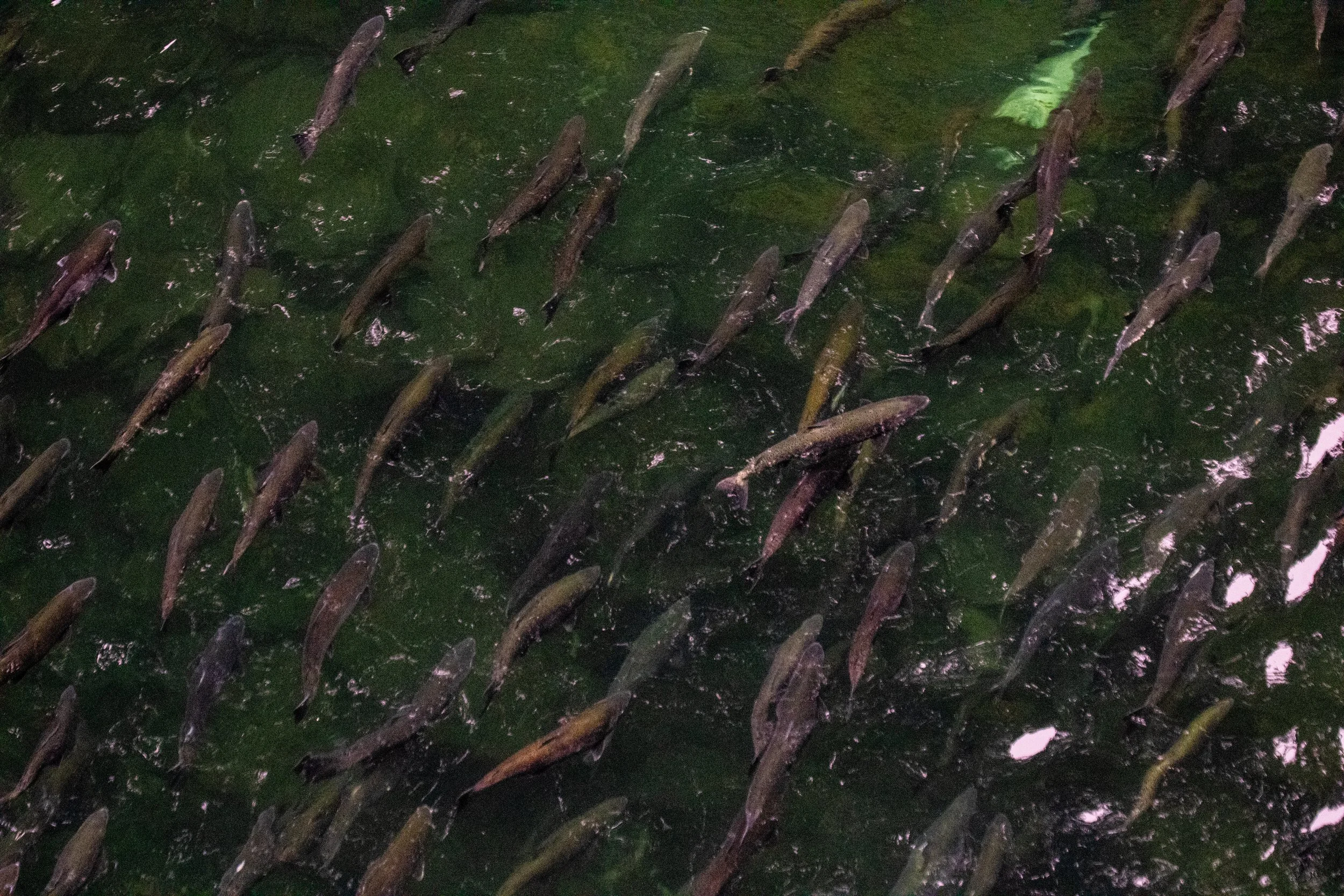
School of Chinook salmon in river pool. Taken by Kendra Nelson
3. Revisions to interagency consultation requirements (ESA Section 7)
Docket Number: FWS–HQ–ES–2025–0044; NMFS-251105-0167
This proposal would revise how federal agencies consult under Section 7 of the Endangered Species Act to ensure that federally funded, authorized, or permitted actions do not jeopardize listed species or destroy or adversely modify critical habitat.
Section 7 consultation is one of the ESA’s most important safeguards. It requires federal agencies to evaluate the effects of their actions before harm occurs, using the best available science, and to avoid or minimize impacts to listed species and their habitat.
The proposed changes would narrow how impacts are evaluated, potentially limiting consideration of indirect, cumulative, or ecosystem-level effects associated with federal actions.
Why this matters:
Many of the most significant threats to imperiled species are not caused by a single action, but by the cumulative effects of multiple stressors over time. Narrowing consultation standards risks overlooking these combined impacts, even when each individual action contributes incrementally to population decline.
Reducing the scope of Section 7 consultation weakens federal accountability and increases the likelihood that harmful projects will proceed without adequate safeguards, undermining the ESA’s preventative intent.
How will this impact orcas and salmon?
Southern Resident killer whales and Pacific salmon are both affected by cumulative impacts associated with federal actions, including shoreline development, in-water construction, vessel traffic, pollution, and alterations to river and nearshore habitats.
For salmon, reduced scrutiny of federal actions can accelerate habitat degradation and prey loss at every life stage. For orcas, these same actions compound existing threats by reducing prey availability and increasing disturbance in critical foraging and travel corridors.
Limiting the ability to fully evaluate cumulative and indirect effects ignores how these species actually experience harm through steady, compounding pressures that erode recovery over time.
4. Expanded discretion to exclude areas from critical habitat (ESA Section 4(b)(2))
Docket Number: FWS–HQ–ES–2025–0048
This proposal would revise how the agencies evaluate whether to exclude areas from designated critical habitat, including how economic and other considerations are weighed in those decisions.
While the ESA already allows limited consideration of economic impacts when designating critical habitat, this proposal would expand agency discretion to exclude areas that are otherwise scientifically justified as essential for species recovery.
Why this matters:
Habitat loss is the leading driver of extinction, and critical habitat protections are among the most effective tools available under the ESA. Expanding exclusion authority risks prioritizing short-term economic interests over long-term species survival and recovery.
Once habitat protections are weakened or excluded, restoration becomes significantly more difficult, more expensive, and in some cases impossible, particularly for species already under stress from climate change.
How will this impact orcas and salmon?Both Southern Resident killer whales and salmon depend on intact, connected habitats that support prey availability, migration, and ecosystem function. Excluding areas from critical habitat increases the risk that development, industrial activity, or infrastructure projects will proceed without adequate safeguards.
For salmon, habitat exclusions can fragment river, estuary, and nearshore systems that are essential for spawning, rearing, and migration. For orcas, the loss or degradation of salmon habitat directly translates to reduced prey availability.
At a time when climate change is reshaping ecosystems and forcing species to adapt, narrowing habitat protections limits resilience and undermines recovery efforts that depend on healthy, functioning ecosystems.
How to submit a public comment:
Visit the links below to submit a comment before December 22, 2025, 11:59 EST. To ensure your voice is counted on all proposed changes, comments should be submitted to each of the four rulemaking dockets.
You can also find each individual docket by visiting the Federal Register and searching the docket number.
Changes to listing, delisting, and critical habitat designations (ESA Section 4)
Docket Number: FWS–HQ–ES–2025–0039; NMFS-251105-0168Weakening protections for threatened species (ESA Section 4(d))
Docket Nubmer: FWS–HQ–ES–2025–0029Revisions to interagency consultation requirements (ESA Section 7)
Docket Number: FWS–HQ–ES–2025–0044; NMFS-251105-0167Expanded discretion to exclude areas from critical habitat (ESA Section 4(b)(2))
Docket Number: FWS–HQ–ES–2025–0048
Tips for public comment:
Avoid pre-written scripts and copy-and-paste templates. New practices make it so that pre-written templates only get counted once. Meaning if multiple people submit the same comment, letter, or email, it will only be recorded once. Make it personal and unique to make sure it is counted.
Cite resources and relevant data that support your comment. Scientific publications referenced in public comments MUST be addressed by policymakers and make for a strong public comment.
Be respectful and polite in your comments, emails, or phone calls.
Get personal, share your experiences, and explain why you care. Personal messages carry more sentiment and weight, which are more meaningful and can have a bigger impact on policymakers. To make this easy, we have included some suggested peer-reviewed and open-access scientific papers below.
Suggested talking points:
The Endangered Species Act is designed to be preventative, not reactive. Delaying protections until species are already in severe decline undermines recovery and increases extinction risk.
ESA listing and habitat decisions must remain based on the best available science, as required by law.
Habitat protection is central to species recovery. Habitat loss is the leading cause of extinction, and critical habitat protections are among the ESA’s most effective tools.
Cumulative and indirect impacts matter. Many species are harmed by multiple stressors over time, not a single action in isolation.
Weakening protections for threatened species increases the likelihood that they will become endangered.
Southern Resident killer whales are critically endangered and depend on healthy Chinook salmon populations for survival and recovery.
Weakening protections for threatened and endangered salmon stocks directly impacts Southern Resident killer whales by reducing prey availability.
Broad, forward-looking habitat protections are essential as climate change alters prey distribution, ocean conditions, and ecosystem function.
Federal actions that degrade salmon habitat, increase vessel disturbance, or fragment ecosystems can collectively undermine recovery even when individual impacts appear small.
The Endangered Species Act is one of the most effective wildlife conservation laws in the world, credited with preventing extinction for the vast majority of species listed under it.
These proposed changes would affect protections for many of the most iconic and beloved endangered species in the United States, including bald eagles, Florida manatees, sea turtles, gray wolves, grizzly bears, Pacific Right Whale, Hawaiian monk seals, whooping cranes, and numerous pollinators, freshwater fish, and native plants. Weakening ESA implementation will affect wildlife across terrestrial, freshwater, and marine ecosystems nationwide.
The loss or decline of these species directly impacts the American people. Healthy wildlife populations support clean water, fisheries, agriculture, pollination, flood control, cultural heritage, recreation, and local economies. When species disappear, ecosystems become less stable and communities lose the natural services they rely on for health, livelihoods, and resilience in the face of climate change.

Members of the Southern Residents in front of Mt Rainier and Commencement Bay. Taken by Tamara Kelley
Read the Oraca Conservancy Comment Letters:
Changes to listing, delisting, and critical habitat designations (ESA Section 4)
Comment on Weakening protections for threatened species (ESA Section 4(d))
Comment on Revisions to interagency consultation requirements (ESA Section 7)
Comment on Proposed Revisions to Regulations Implementing ESA Section 4(b)(2)
Scientific Resources:
1. Seminal Paper on Habitat Loss and Extinction
Pimm, S.L., Jenkins, C.N., et al. (2014).
The biodiversity of species and their rates of extinction, distribution, and protection.
Science, 344(6187), 1246752.
➔ Key Point: Habitat loss is the leading driver of species extinction worldwide.
https://www.science.org/doi/10.1126/science.1246752
2. Habitat Criticality for Species Recovery
Tear, T.H., et al. (1995).
Recovery plans and the Endangered Species Act: are criticisms supported by data?
Conservation Biology, 9(1), 182–195.
➔ Key Point: Species recovery overwhelmingly depends on protecting and restoring critical habitat.
https://conbio.onlinelibrary.wiley.com/doi/epdf/10.1046/j.1523-1739.1995.09010182.x
3. Habitat Fragmentation and Extinction Risk
Faurby, S., Davis, M., Pedersen, R. Ø., et al. (2018).
Quantifying the extinction risk of mammals: Fragmentation and population decline are key predictors.
Proceedings of the National Academy of Sciences, 115(33), 8321–8326.
➔ Key Point: Habitat fragmentation significantly increases extinction risk in terrestrial mammals.
https://pubmed.ncbi.nlm.nih.gov/28673992/
4. Effectiveness of Protected Areas
Geldmann, J., Barnes, M., Coad, L., Craigie, I. D., Hockings, M., & Burgess, N. D. (2013).
Effectiveness of terrestrial protected areas in reducing habitat loss and population declines.
Biological Conservation, 161, 230–238.
➔ Key Point: Protected areas are generally effective at reducing forest habitat loss, though outcomes depend on management quality.
https://www.sciencedirect.com/science/article/pii/S0006320713000670
5. Marine Protected Areas and Endangered Species Use
Moore, J. W., Yeakel, J. D., et al. (2020).
Evaluating the use of marine protected areas by endangered species: A habitat selection approach.
Ecological Solutions and Evidence, 1(1), e12035.
➔ Key Point: MPAs that align with habitat preferences of endangered species are more effective at supporting recovery.
https://besjournals.onlinelibrary.wiley.com/doi/full/10.1002/2688-8319.12035
6. Are Restoration Efforts Targeting Species’ Needs? (Pacific Salmon Case Study)
Pess, G. R., Steel, E. A., et al. (2014).
Is habitat restoration targeting relevant ecological needs for endangered species? Using Pacific salmon as a case study.
Ecosphere, 5(5), 1–18.
➔ Key Point: Misalignment between restoration goals and ecological needs can limit effectiveness for endangered species.
https://esajournals.onlinelibrary.wiley.com/doi/10.1890/ES14-00466.1
Donate