ACTION ALERT: Submit a Public Comment Supporting Science-Based Protections for Orcas in Military Testing Sites
Submit a public comment urging the U.S. Navy to use the best available science in its Northwest Training and Testing environmental review to evaluate and reduce risks to endangered Southern Resident killer whales and other marine life.
Public comments are due by January 19, 2026, at 11:59 p.m. PST.
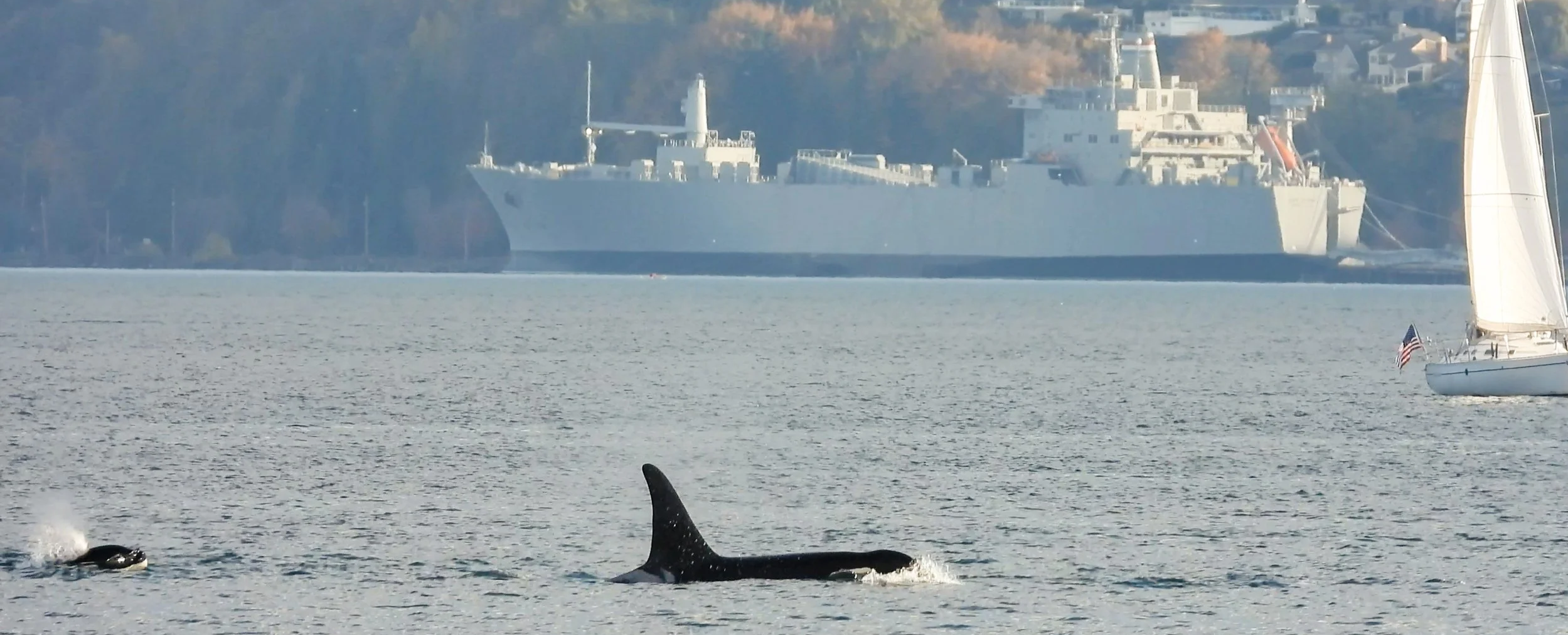
L115 Mystic in front of a United States Naval Ship. Photo by Tamara Kelley
What is happening and why it matters?
The United States Navy (USN) and the United States Coast Guard (USCG) are preparing a Supplemental Environmental Impact Statement / Overseas Environmental Impact Statement (SEIS/OEIS) to evaluate ongoing and future at-sea training and testing activities in the Pacific Northwest, including locations within designated and protected habitat of the critically endangered Southern Resident killer whales (SRKWs).
This process is part of the Navy’s responsibility under the National Environmental Policy Act (NEPA) to periodically reassess how its activities interact with changing environmental conditions, new scientific understanding, and the presence of protected species such as the SRKWs. The SEIS/OEIS will examine whether existing analyses remain sufficient and whether adjustments or alternatives should be considered.
Under the National Environmental Policy Act (NEPA), this public scoping and comment period (open through January 19, 2026) seeks input from scientists, Tribes, coastal communities, conservation organizations, industry, and the general public. These comments help the Navy and Coast Guard understand which issues warrant deeper analysis, what alternatives should be considered, and how to effectively apply current science when evaluating potential environmental effects. Recognizing that national defense readiness and ocean stewardship both matter, this is a constructive forum to ensure decisions are well-informed and balanced.
The SEIS/OEIS will inform decisions about continuing at-sea training and testing beyond current permit expirations in 2027, and will support reissuance of federal authorizations under the Marine Mammal Protection Act and consultations under the Endangered Species Act. Activities analyzed may occur offshore of Washington, Oregon, and Northern California; in inland Washington waters; and in the Western Behm Canal in Southeast Alaska.
Types of Activities
The following testing and training activities occur on and beneath the surface and in associated airspace, and are analyzed for potential effects on marine species, habitats, and ecological functions. The SEIS/OEIS process is meant to ensure that updated scientific evidence is factored into decisions about how, when, and where these activities occur
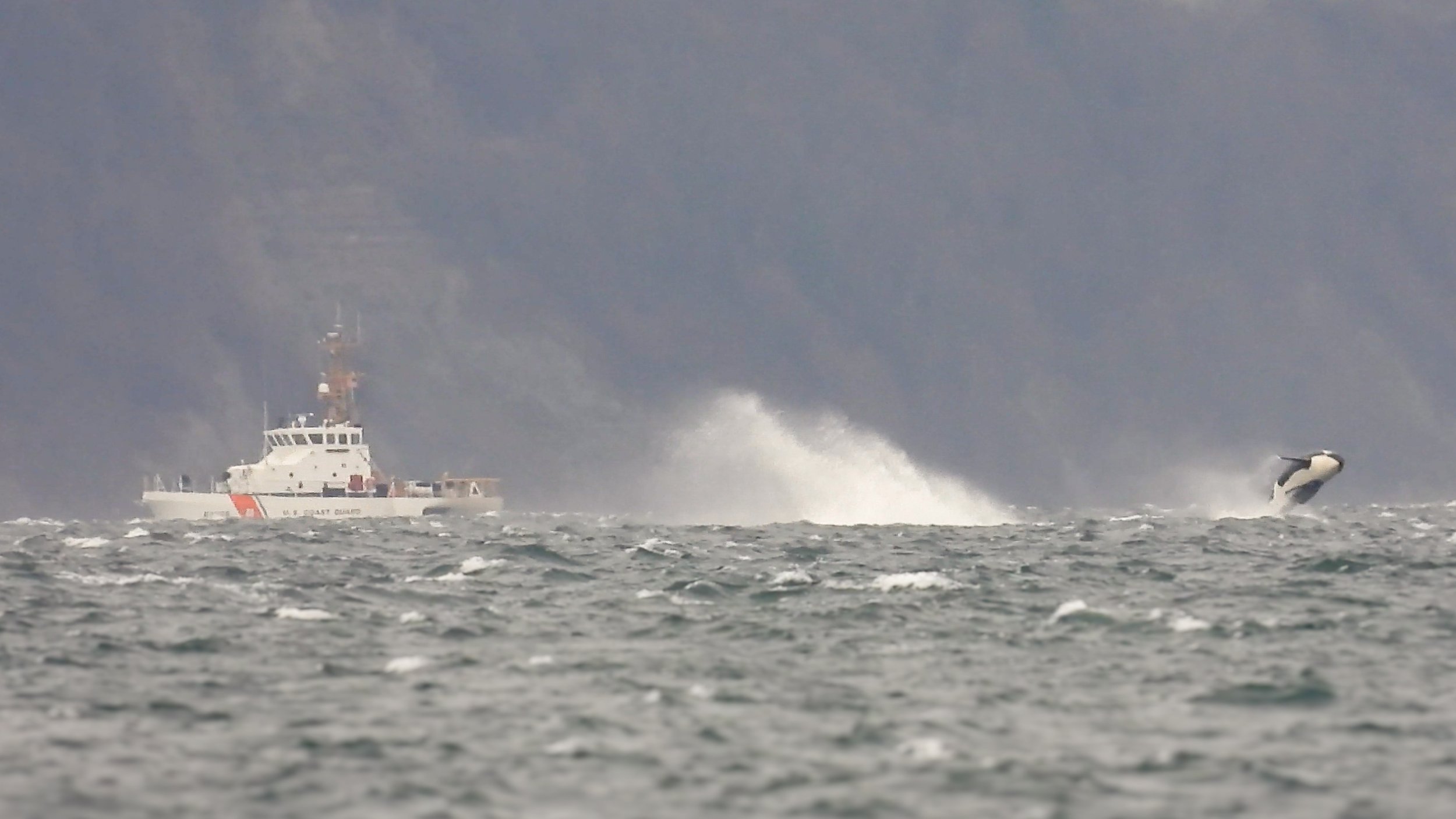
Member of K Pod breaching next to USCG Cutter. Photo by Tamara Kelley
Active Sonar Operations – Employed to train personnel and test systems in detecting underwater objects and navigation.
Explosive Ordnance Training/Testing – Use of controlled detonations to train personnel and validate equipment performance.
Vessel Maneuvering & Surface Operations – Movement and tactical operation of ships and associated craft.
Underwater Device Deployment – Use of unmanned underwater vehicles (UUVs), towed arrays, and other devices for training or testing purposes.
Research, Development, Testing & Evaluation (RDT&E) – Performance assessment of evolving technologies needed for readiness.
Range Modernization & Sustainment – Maintenance and upgrades of training and testing infrastructure to support ongoing activities. NEPA
Key Training & Testing Areas
While a full suite of locations spans the NWTT Study Area, several are especially relevant because they overlap with or influence waters used by Southern Resident killer whales:
Offshore Washington Coast – Portions of the Pacific Ocean where acoustic sources (e.g., sonar) can propagate into areas used by whales for foraging and movement.
Inland Waters of Washington – Includes Puget Sound and the Strait of Juan de Fuca; these inland waterways are core components of SRKW range and critical habitat.
Adjacent Offshore Areas (Oregon & Northern California) - While farther from the most frequently used portions of designated Southern Resident killer whale critical habitat, this region is known to be used by both K and L Pods. Activities in these offshore areas contribute to the broader acoustic environment and may influence whale movement patterns, as well as affect transient (Bigg’s) killer whales and other marine mammals that use these waters.
Western Behm Canal, Southeast Alaska - A northern extension of the Northwest Training and Testing Study Area, this region is less directly associated with the SRKWs but remains part of the integrated training footprint analyzed under the SEIS/OEIS. Activities here have implications for other orca populations, including Northern Resident killer whales (NRKWs) and Bigg’s (Transient) killer whales, both of which are listed as Threatened under Canada’s Species at Risk Act (SARA).
How will this impact orcas and other species?
Southern Residents are acoustic animals and rely on echolocation for survival. Echolocation and acoustic calls allow them to locate and identify prey, coordinate group foraging, maintain social bonds, and navigate their environment. Scientific research has shown that even modest increases in background noise can interfere with these essential behaviors.
The direct impacts of sonar on Southern Resident killer whales were observed and documented in May 2003, when whales were exposed to U.S. Navy sonar. During this exposure, researchers documented interruptions to foraging behavior, changes in dive patterns, and temporary displacement from preferred habitat.
Noise does not need to cause physical injury to be biologically significant. When echolocation is masked, whales spend more time searching for food, expend additional energy, or abandon productive foraging areas altogether. In the 1990s, the use of high-amplitude acoustic harassment devices (AHDs) at salmon farms in British Columbia was associated with a marked decline in Northern Resident killer whale presence in affected areas, demonstrating that sufficiently intense or persistent acoustic disturbance can cause resident orcas to avoid or abandon important travel or foraging habitat.
This finding is particularly relevant for Southern Residents because active military testing areas overlap with designated Southern Resident critical habitat. Increased noise in these areas raises the risk of displacement from essential foraging habitat, compounding existing stressors such as prey limitation and vessel traffic.
How to Submit a Public Comment:
Submit online at>>>>> Northwest Training and Testing Supplemental EIS/OEIS Comments
or copy and paste the following URL: https://www.nepaeimscommenting.com/Comment/Submit?projid=63)
Submit by mail:
Naval Facilities Engineering Systems Command Northwest
Attention: NWTT SEIS/OEIS Project Manager
1101 Tautog Circle, Room 102
Silverdale, WA 98315-1101
Deadline: January 19, 2026 at 11:59 p.m. PST.
Tips for Submitting a Public Comment:
Cite relevant scientific research and data to support your comment. The Navy has explicitly requested scientific resources during this scoping period, and peer-reviewed publications included in public comments help inform the environmental analysis and decision-making process.
Avoid pre-written scripts and copy-and-paste templates. New practices make it so that pre-written templates only get counted once. Meaning if multiple people submit the same comment, letter, or email, it will only be recorded once. Make it personal and unique to make sure it is counted.
Be respectful and polite in your comments, emails, or phone calls.
Get personal, share your experiences, and explain why you care. Personal messages carry more sentiment and weight, which are more meaningful and can have a bigger impact on decisionmakers.
Suggested talking points:
Peer-reviewed research shows that underwater noise can disrupt echolocation and reduce foraging success in Southern Resident killer whales, increasing energetic costs at a time when prey availability is already limited.
Studies indicate that noise-related reductions in foraging efficiency disproportionately affect reproductive females, who have higher energetic demands and are critical to population recovery.
In May 2003, Southern Resident killer whales exposed to U.S. Navy sonar were documented interrupting foraging, altering dive behavior, and temporarily leaving preferred habitat, showing in real-time the harm and disruption these types of activities have in an already struggling population.
The use of high-amplitude acoustic deterrent devices at salmon farms in British Columbia during the 1990s was associated with a marked decline in Northern Resident killer whale presence, demonstrating that sufficiently intense or persistent noise can displace resident orcas from important travel or foraging areas.
Because Navy training and testing occur within and adjacent to designated Southern Resident killer whale critical habitat, acoustic disturbance poses a risk of displacement from essential foraging areas.
SRKWs are listed as endangered under the U.S. Endangered Species Act, protected under the Marine Mammal Protection Act, and protected under Washington and Oregon state law, requiring precautionary, science-based mitigation to avoid additional harm.
There are proven tools to reduce risk to protected wildlife while supporting military readiness, including enhanced monitoring, hydrophone networks, real-time detection, seasonal or spatial adjustments, and adaptive management informed by current science.
Incorporating updated acoustic models, current marine mammal density data, and recent peer-reviewed research will improve the accuracy of the environmental analysis and help prevent unintended impacts to endangered species.
Acoustic disturbance is one of three primary threats facing the critically endangered Southern Resident killer whale population, interacting with prey limitation and contaminant exposure to produce cumulative and synergistic effects.
Scientific Resources:
Foraging Disruption, Energetics & Reproductive Females
Holt, M. M., Tennessen, J. B., Hanson, M. B., et al. (2021) — Vessels and their sounds reduce prey capture effort by endangered killer whales (Orcinus orca). Marine Environmental Research, 170, 105429.
Demonstrates reduced prey capture effort associated with vessel noise; directly relevant to energetic impacts, including heightened risk for lactating females.
https://doi.org/10.1016/j.marenvres.2021.105429Williams, R., Clark, C. W., Ponirakis, D., & Ashe, E. (2014) — Acoustic quality of critical habitats for three threatened whale populations. Animal Conservation, 17(2), 174–185.
Shows how noise degrades functional habitat quality and increases energetic costs.
https://doi.org/10.1111/acv.12076
Southern Resident Killer Whales & Sonar Exposure
Bain, D. E. (2003) — Responses of Southern Resident killer whales to a U.S. Navy sonar exercise.
Documents behavioral disruption of SRKWs during a naval sonar exercise in the Salish Sea, including altered movement and foraging behavior.
http://www.eurocbc.org/usn_sonar_jpod_shoup_page1010.htmlSivle, L. D., et al. (2012) — Changes in dive behavior during naval sonar exposure in killer whales. Proceedings of the Royal Society B, 279(1730), 1231–1240.
Controlled exposure experiments showing significant behavioral changes in response to mid-frequency active sonar.
https://pmc.ncbi.nlm.nih.gov/articles/PMC3468818/
Northern Resident Killer Whales & Acoustic Deterrent Devices
Morton, A. B., & Symonds, H. K. (2002) — Displacement of Orcinus orca by high-amplitude sound in British Columbia. ICES Journal of Marine Science, 59(1), 71–80.
Documents a marked decline in killer whale presence associated with the use of high-amplitude acoustic harassment devices (AHDs) at salmon farms.
https://doi.org/10.1006/jmsc.2001.1136
Noise, Habitat Displacement & Functional Habitat Loss
Holt, M. M., et al. (2021) — Noise-mediated loss of foraging habitat for endangered killer whales. Frontiers in Marine Science, 8:649749.
Demonstrates how noise reduces usable habitat even without physical exclusion or injury.
https://www.frontiersin.org/articles/10.3389/fmars.2021.649749/fullTennessen, J. B., et al. (2024) — Auditory masking from vessel noise impairs foraging efficiency and success in killer whales.
Global Change Biology.
https://doi.org/10.1111/gcb.17490
Cumulative Effects, Population Viability & Recovery Risk
Lacy, R. C., et al. (2017) — Evaluating anthropogenic threats to endangered killer whales. Biological Conservation, 210, 71–80.
Demonstrates how small increases in stress or mortality can significantly affect SRKW population viability.
https://www.nature.com/articles/s41598-017-14471-0NOAA Fisheries (2025) — Southern Resident Killer Whale Recovery Plan.
Confirms prey limitation, acoustic disturbance, and contaminants as primary, interacting threats.
https://www.fisheries.noaa.gov/west-coast/endangered-species-conservation/southern-resident-killer-whale-recovery-planning-and
Donate